laboratoire écologie et art pour une société en transition
Eyes on TikTok
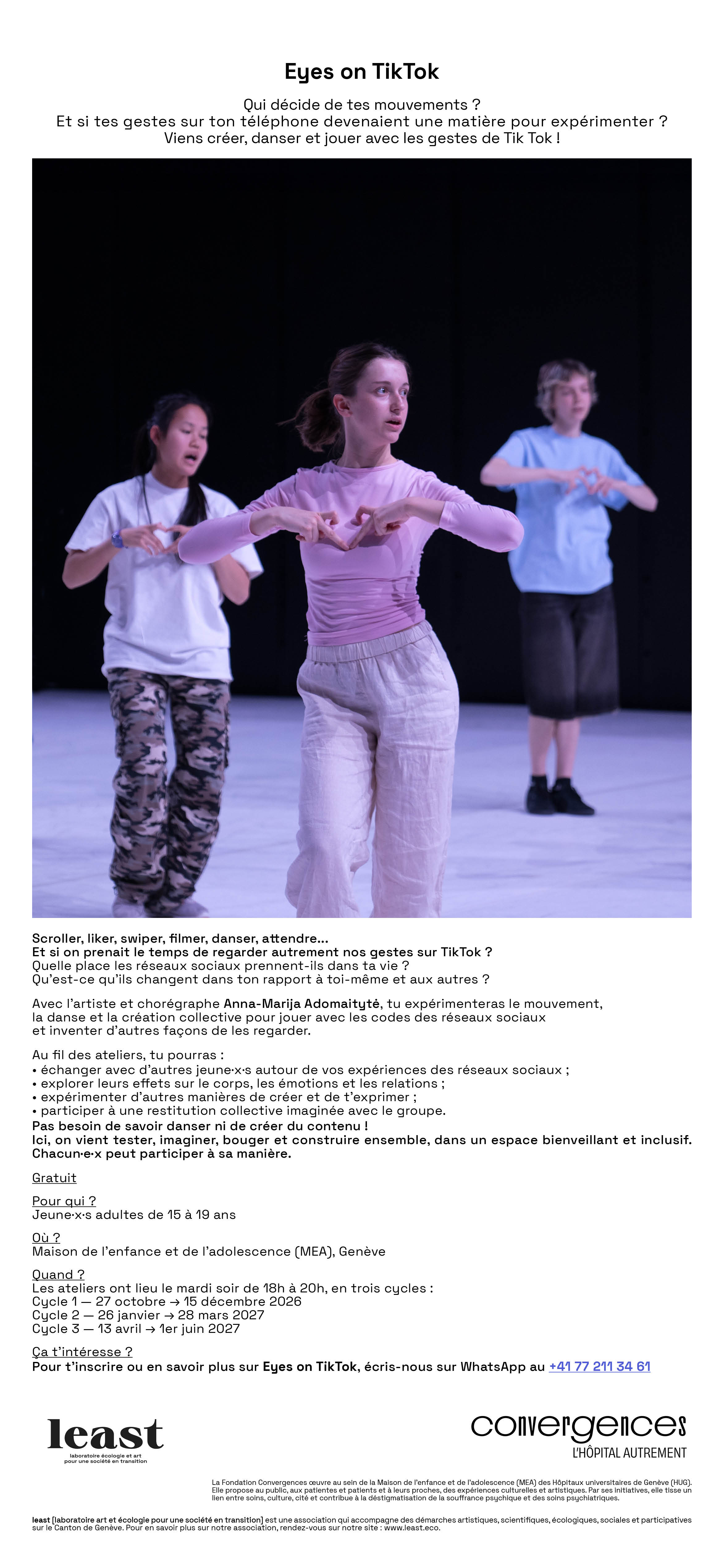
Eyes on TikTok is a co-creative project exploring young people’s mental health, social media and the body, initiated by artist Anna-Marija Adomaitytė and least. The project invites young people aged 15 to 19 to take part in a process of creative exploration and reflection through movement workshops, group discussions and creative practices involving social media.
The project begins by creating a space where young people can share their concerns, desires and personal experiences of social media use, without imposing an adult perspective on the subject. These exchanges will provide a starting point for discussing both the risks and positive aspects of TikTok, while exploring the relationships between algorithms, emotions and mental health. Participants will also be invited to engage directly with the TikTok app—observing, questioning, disrupting and experimenting with the ways it is used. In doing so, they will explore conscious and inventive strategies for reshaping their relationship with the platform and reclaiming it as a space for expression rather than pressure.
The movement practice developed through the creative process behind TikTok-Ready Choreographies (created by Anna-Marija Adomaitytė, Pavillon ADC, Théâtre Vidy-Lausanne, 2024) draws on group improvisation techniques accessible to everyone. It incorporates familiar gestures from the virtual world and everyday life, using them as material for collective movement. Participants will explore the qualities this performative practice can foster and strengthen, including confidence, imagination, autonomy, body awareness and the experience of taking part in a shared practice.
The project aims to offer young people a space for listening, experimentation and creative exploration, where they can investigate the complexities of their relationship with TikTok and develop forms of resistance, solidarity and care in response to the mental health challenges associated with social media.
Steps Completed
Since autumn 2025, least has been working closely with the Convergences Foundation of the Maison de l’Enfance et de l’Adolescence (MEA) at HUG. This collaboration has become an important source of support and a key point of connection in bringing the artistic and cultural project to life with young people.
The partnership has notably enabled the formation of the transdisciplinary team leading the project. The team includes choreographer and artist Anna-Marija Adomaitytė, alongside Lou Bertossa, an actress in training and artist-in-residence at least for the project.
Lou took part in TikTok-Ready Choreographies. Her involvement brings a particularly valuable perspective to the project, grounded in her own experience of adolescence, enriched by her collaboration with Anna-Marija Adomaitytė and informed by her ongoing development as an artist.
The team also includes Carole Barnetche, a psychomotor therapist specialising in working with young people, notably at the MEA. Throughout the project, she will help provide a supportive framework for listening, care and well-being.
In Progress
The transdisciplinary team and least are currently developing the workshop programme, which will run from autumn 2026 through to the end of spring 2027.
The aim is to meet and build relationships with young people from a wide range of backgrounds, particularly through partnerships such as the one currently being developed with the ForPro Foundation, whose mission is to encourage, support, promote and advocate for vocational training among young people, their families and businesses across the canton of Geneva.
Our teams are also meeting with new organisations and potential partners that work directly with young people in their local communities, including community centres.
least is committed to acting as a bridge between the different organisations working with young people, forging connections and facilitating dialogue between them. The aim is to create stronger links between extracurricular and leisure activities, educational support and guidance, and mental health services.
Upcoming
The first cycle of workshops will run from 27 October to 15 December 2026, the second from 26 January to 28 March 2027, and the third from 13 April to 1 June 2027.
During each cycle, workshops will take place every Tuesday evening from 6 to 8 p.m. at the Maison de l’Enfance et de l’Adolescence (MEA) at HUG. They will be structured around three main areas:
• Collective discussions: in small groups, participants will be invited to share their experiences, emotions and questions relating to their use of TikTok.
• Creative practices: participants will engage with TikTok through critical observation and the creation of videos, collages and collective posts, exploring ways of transforming the platform into a space for expression, play and reflection.
• Movement practice: accessible exercises will take familiar gestures from everyday life and the virtual world as their starting point. The practice will invite participants to reconnect with their bodies through a heightened awareness of gesture, while exploring collective forms of improvisation and shared movement.
Although each cycle will culminate in some form of public presentation, Eyes on TikTok is conceived as a long-term project. It unfolds as a continuous process punctuated by intermediate stages, creating a stimulating rhythm while nurturing and sustaining young people’s desire to participate over time.
newsletter
All participatory actions and locations will be communicated on our website and via least’s newsletter.
sign up now!
Transdisciplinary Team
Anna-Marija Adomaitytė – choreographer and artist, founder of A M A
Carole Barnetche – psychomotor therapist
Lou Bertossa – artist-in-residence at least
Elisa Radosta – Member of the Management Team – Head of Institutional Relations and Communications at the Convergences Foundation
least would like to thank everyone who has contributed to the project by generously sharing their time, knowledge and resources:
The Convergences Foundation of the Maison de l’Enfance et de l’Adolescence (MEA) at HUG; the ForPro Foundation; Caroline Grondahl; Laurence Jaquet; Elisa Radosta
médias
Cruel optimism
Reading
“Cruel optimism”, according to Lauren Berlant, refers to what grates on our desires and prevents us from carrying on as hoped
least
How happy is the little stone
Reading
Emily Dickinson celebrates the happiness of a simple, independent life.
Peau Pierre
Arpentage
Faire commun
d’un champ à l’autre / von Feld zu Feld
Intimity Among Strangers
Reading
Lichens tell of a living world for which solitude is not a viable option
Common Dreams
Faire commun
CROSS FRUIT
Cruel optimism
“A relation of cruel optimism exists when something you desire is actually an obstacle to your flourishing. It might involve food, or a kind of love; it might be a fantasy of the good life, or a political project. It might rest on something simpler, too, like a new habit that promises to induce in you an improved way of being. These kinds of optimistic relation are not inherently cruel. They become cruel only when the object that draws your attachment actively impedes the aim that brought you to it initially.”
These are the opening words of Cruel Optimism, a book by theorist Lauren Berlant that, in recent years, has become a key reference for anyone thinking seriously about affect, desire and precarity.
Who hasn’t, at least once, believed that working harder than necessary would help us get ahead? Or that a toxic relationship was better than being alone? Or that political commitment, on its own, could truly change things? All these promises eventually start to creak. And behind that creaking, Berlant identifies a deeper, more pervasive feeling that runs through many contemporary lives: the impasse – a condition in which we keep moving forward without really knowing where we’re going, where we’re surviving more than living, where change is both longed for, feared and always somehow postponed.
Drawing: Anaëlle Clot.
But Berlant doesn’t stop at diagnosis. They invite us to pay attention to the micro-tactics through which people try to survive within the impasse. They call these forms “self-interruption”: tiny gestures like eating erratically, compulsively scrolling, binge-watching endless series, procrastinating – things we often regard as bad habits or self-sabotage. Yet in Berlant’s reading, these are also reprieves, pauses in the relentless push for productivity, fleeting moments where the self finds shelter; acts that, while they may not change the world, express a desire to keep going and in that very persistence, carry a quiet political force.
To live in an exhausting world and somehow manage – even just for today – not to fall apart, is already a form of resistance.
Perhaps, then, we might learn something from this stance: to be gentler with ourselves, to allow space for rest, for emptiness, for pause. To accept doing nothing, from time to time, can be an act of care. And it is also a way of desiring a more liveable world.
How happy is the little stone
In this brief poetic composition, Emily Dickinson celebrates the happiness of a simple, independent life, represented by a small stone wandering freely. Far from human worries and ambitions, the stone finds contentment in its elemental existence. Written in the 19th century, the poem reflects the growing disillusionment with industrialisation and urbanisation, which led many to aspire to a more modest and meaningful life.
How happy is the little stone
That rambles in the road alone,
And doesn’t care about careers,
And exigencies never fears;
Whose coat of elemental brown
A passing universe put on;
And independent as the sun,
Associates or glows alone,
Fulfilling absolute decree
In casual simplicity
Image: Altalena.
Intimity Among Strangers
Covering nearly 10% of the Earth’s surface and weighing 130.000.000.000.000 tons—more than the entire ocean biomass—they revolutionised how we understand life and evolution. Few would probably bet on this unique yet discrete species: lichens.
Four hundred and ten million years ago, lichens were already there and seem to have contributed, through their erosive capacity, to the formation of the Earth’s soil. The earliest traces of lichens were found in the Rhynie fossil deposit in Scotland, dating back to the Lower Devonian period—that of the earliest stage of landmass colonisation by living beings. Their resilience has been tested in various experiments: they can survive space travel without harm; withstand a dose of radiation twelve thousand times greater than what would be lethal to a human being; survive immersion in liquid nitrogen at -195°C; and live in extremely hot or cold desert areas. Lichens are so resistant they can even live for millennia: an Arctic specimen of “map lichen” has been dated 8,600 years, the world’s oldest discovered living organism.
Lichens have long been considered plants, and even today many interpret them as a sort of moss, but thanks to the technical evolution of microscopes in the 19th century, a new discovery emerged. Lichen was not a single organism, but instead consisted of a system composed of two different living things, a fungus and an alga, united to the point of remaining essentially indistinguishable. Few know that the now familiar word symbiosis was coined precisely to refer to this strange structure of lichen. Today we understand that lichens are not simply formed by a fungus and an alga. There is, in fact, an internal variability of beings involved in the symbiotic mechanism, frequently including other fungi, bacteria and yeasts. We are not dealing with a single living organism but an entire biome.
Symbiosis’ theory was long opposed, as it undermined the taxonomic structure of the entire kingdom of the living as Charles Darwin had described it in On the Origin of Species: a “tree-like” system consisting of progressive branches. The idea that two “branches” (and, moreover, belonging to different kingdoms) could intersect called everything into question. Significantly, the fact that symbiosis functioned as a mutually beneficial cooperation overturned the idea of the evolutionary process as based on competition and conflict.
Symbiosis is far from being a minority condition on our planet: 90% of plants, for example, are characterised by mycorrhiza, a particular type of symbiotic association between a fungus and the roots of a plant. Of these, 80% would not survive if deprived of the association with the fungus. Many mammalian species, including humans, live in symbiosis with their microbiome: a collection of microorganisms that live in the digestive tract and enable the assimilation of nutrients. This is a very ancient and specific symbiotic relationship: in humans, the genetic difference in the microbiome between one person and another is greater even than their cellular genetic difference. Yet the evolutionary success of symbiotic relationships is not limited to these incredible data: it is the basis for the emergence of life as we know it, in a process described by biologist Lynn Margulis as symbiogenesis.
Symbiogenesis posits that the first cells on Earth resulted from symbiotic relationships between bacteria, which developed into the organelles responsible for cellular functioning. Specifically, chloroplasts—the organelles capable of performing photosynthesis—originated from cyanobacteria, while mitochondria—the organelles responsible for cellular metabolism—originated from bacteria capable of metabolising oxygen. Life, it seems, evolved from a series of symbiotic encounters, and despite numerous catastrophic changes in the planet’s geology, atmosphere and ecosystems across deep time, has been flowing uninterruptedly for almost four billion years.
Several scientists tend to interpret symbiosis in lichens as a form of parasitism on the part of the fungus because it would gain more from the relationship than the other participants. To which naturalist David George Haskell, in his book The Forest Unseen, replies, “Like a farmer tending her apple trees and her field of corn, a lichen is a melding of lives. Once individuality dissolves, the scorecard of victors and victims makes little sense. Is corn oppressed? Does the farmer’s dependence on corn make her a victim? These questions are premised on a separation that does not exist.” Multi-species cooperation is the basis of life on our planet. From lichens to single-celled organisms to our daily lives, biology tells of a living world for which solitude is not a viable option. Lynn Margulis described symbiosis as a form of “intimacy among strangers”: what lies at the core of life, evolution and adaptation.